
Travel Diaries
MY TALES FROM THE WORLD
Bring the thrill of discovery home.
This collection is a visual diary, a tribute to the journeys undertaken and the cultures encountered. Every brushstroke is a memory, a story, an emotion.
These paintings don't just decorate; they narrate stories of distant lands, moments of deep reflection, and the eternal call to adventure.
Every piece is a unique creation, with no copies made. To ensure the uniqueness of your home, purchase or contact me immediately
Pakistani Threads
We do not travel to escape life, but so that life does not escape us.
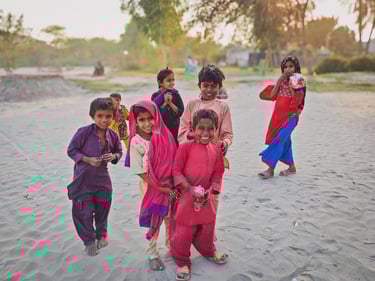
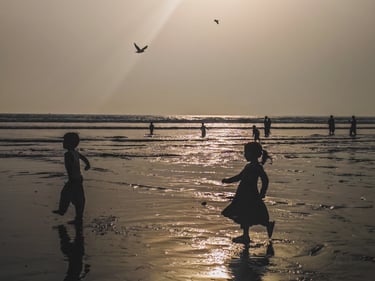
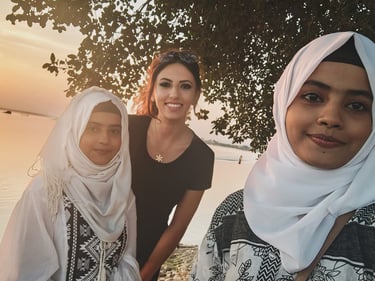
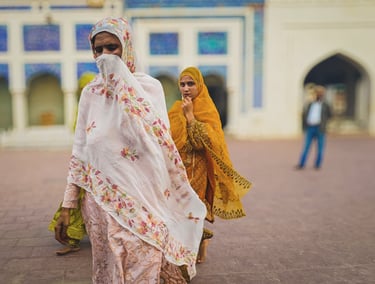
This is the country where I have certainly grown the most: I saw the purest innocence in children, I witnessed what it means to LIVE and smile without having anything. I saw people working tirelessly to earn a few cents a day, enduring hardships, with summer heat that would suffocate any form of life.
Yet, people are used to it; they tolerate the heat, they tolerate the poverty; they live with it every day, almost as if it were no longer a burden. And while we (myself included) cannot live without a hairdryer, they can live regardless of anything. The people are immensely kind, polite, and respectful.
The most powerful experience:
I was walking through a market; as soon as I got out of the car, I thought about taking beautiful photos of their daily life, so different from ours... A group of three barefoot children, with wounds on their faces, torn clothes, and dusty little faces, approached me: they observed me curiously, happy, and smiling.
And me? I stood there, speechless; I couldn't even look at them or return their smile. I felt terribly guilty, almost as if I had caused their injuries, as if I were the reason for their torn clothes, as if I were guilty of who knows what crimes against humanity.
And I thought, "Why do they look at me as if I were the most beautiful creature they have ever seen? Why don't they hate me?" I truly couldn't look at them, nor could I take a souvenir photo.
And then, only hours later, I understood.
They don't hate; they don't even know what that feeling is. Their reality is just that; they have no idea of our comforts and perhaps they don't even care; they harbor no resentment. I immediately returned to the car; I didn't want to, and couldn't, understand at that moment. That feeling of guilt wouldn't leave.
But that is where I grew: you cannot truly understand how fortunate we are until you find yourself face-to-face with such diversity. And so many things I once took for granted are not a privilege for everyone.
...When we come into the world, we are overwhelmed not only by the affection of our loved ones but also by gifts, toys, and everything else. But there are mothers who do not have the opportunity to guarantee their child food, necessary care, a stable roof, or even one shirt that isn't too torn. All this, without considering that for those people, a child is one of their greatest assets, because they don't have the opportunities to go out and party with friends, to have a comfortable home, a job, or a degree that makes them feel fulfilled.
None of us can save the world, but one thought naturally arises: the universe exists because everything is in a perfect, perpetual balance, without which it would be destined to collapse upon itself or expand until it is depleted. And this balance does not exist on this earth; it is completely missing.
Being aware of this certainly helps us to be even happier, to appreciate the "too much" that we have, never taking it for granted, and to value the small things more and more...
However, this journey, in addition to human experiences, has enriched me with a wealth of culture. It helped me better understand all the issues of political instability in the East and the difficult relationships between these countries and terrorist groups.
Pakistan is a beautiful country, and I can confidently say that I never felt the slightest bit of danger.
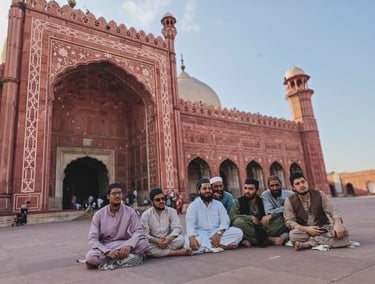
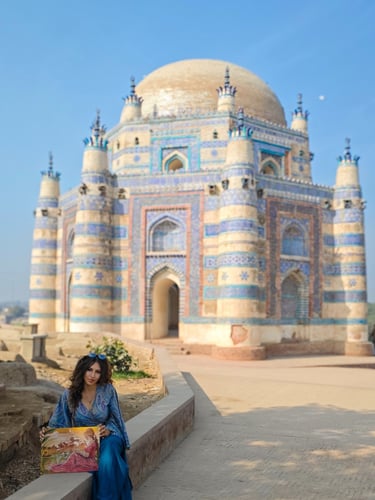
It is truly worth visiting this country: from the beautiful city of Peshawar with its blue-eyed Afghan population, to the beautiful and colorful architectural structures that dot the landscape, to the Buddhist temples, mosques, and the mysticism of the Sufis, which is something truly surreal. I saw people start dancing to the rhythm of flutes and drums and literally lose themselves within themselves, as a kind of meditation or self-induced hypnosis to connect with the divine—one of the most incredible things I have ever seen.
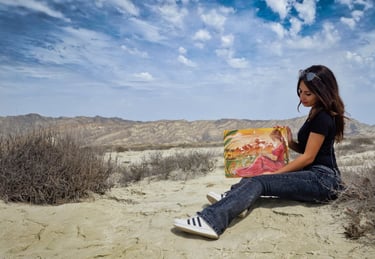
...And then the fabulous Hingol National Park in Balochistan, on the border with Iran, where the mountains look like a "sea of rock in a storm"—it truly feels like being on an alien planet.
It was a unique and indescribable experience, and I admired Arbaz for enduring the burdens of us "spoiled" Westerners... with our hairdryers, cameras, necessarily dark chocolate biscuits, and photos in improbable places...
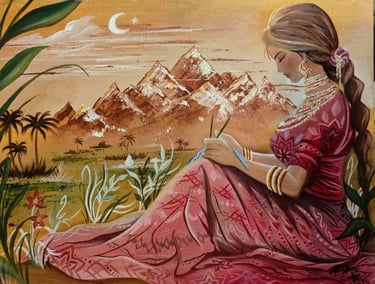
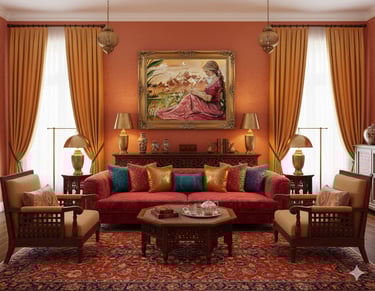
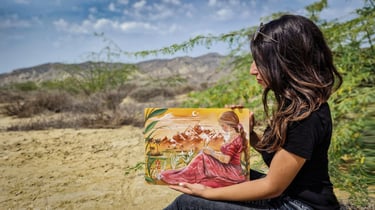
The title "PAKISTANI THREADS" symbolizes the intricate fabric of cultures, faith, and human contrasts that make up the country. The painting is the visual synthesis of a journey that proved to be a direct confrontation with a reality of extreme poverty, which is, paradoxically, rich in kindness, dignity, and joy.
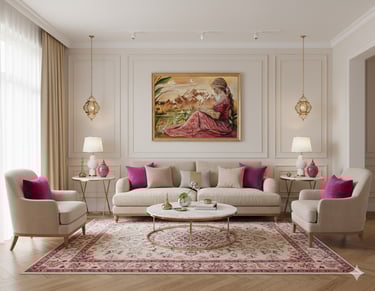
The composition unites the human figure in meditation with the raw and majestic beauty of the Balochistan mountains. The female figure, immersed in the landscape, wears a traditional dress with intricate patterns, representing the complex and rich Pakistani culture and the "threads" of history and tradition. Her act of sewing suggests the creation of beauty and the act of weaving one's own destiny or understanding the cosmic order (a reference to Sufi mysticism), as well as calling attention to this important activity of Pakistani women.
Ideal for collectors and travelers seeking art with a strong cultural, anthropological, ethical, and meditative resonance. A piece that honors the dignity of people and reflects on the need to rediscover balance and gratitude in modern life.
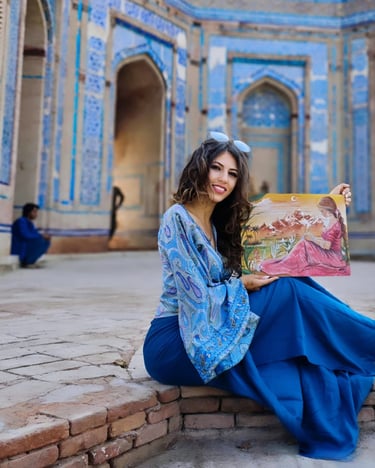
P.S. The woman depicted in the painting is born from a true story.
Support and Materials: Oil on Canvas. 30x40 cm
Indian Immortality
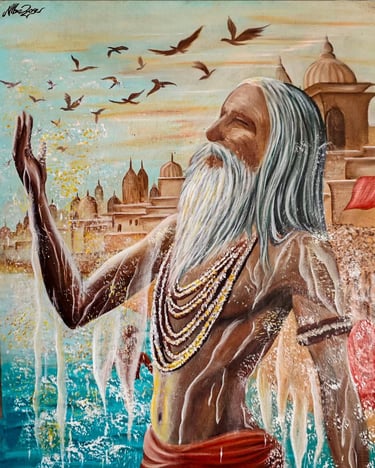
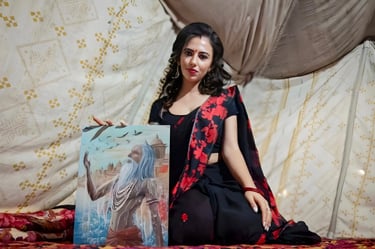
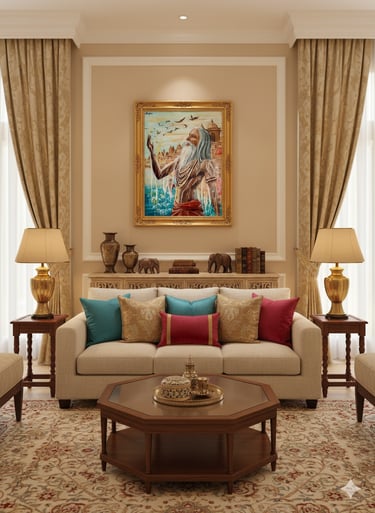
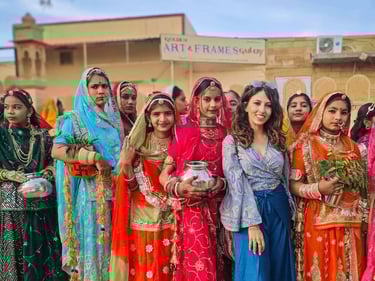
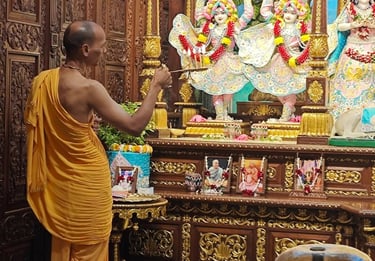
A representation that captures the spirituality and wisdom of India.
I begin by thanking a wonderful person who believed in me from the very first moment, who gave me the strength to overcome fears and obstacles; who, even when I didn't remotely believe in their words or in myself, would say: “You will soon see the world, you will grow and you will see with your own eyes what beauty is.” Those words, like seeds in the ground, grew within me so much that they became marvelous flowers. Now I understand what they meant.
It is not always simple to accept diversity, especially when it is vastly different from our own reality, or to see the glass half full when the rules of our society tell us it is half empty, while simultaneously trying to grow. And they were right; I didn't find it that difficult to go "beyond." And here in India, I found confirmation of that.
I read that you either love India or you hate it. And indeed, that is true: no Indian knows table manners, the streets are immersed in chaos, endless shantytowns stand before some of the most modern skyscrapers in the world, and everyone chews betel nuts, spitting everywhere. There are those who stop at these aspects because, frankly, they are aggressive...
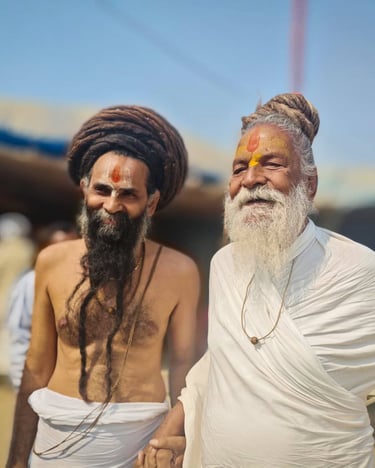
And then there are those who try to see the beauty, because they believe that beauty is a prerequisite for existence itself: there are millions of smiles, the serenity, the kindness, and the immense welcome that allows people to help each other and not ignore one another. There is that ability to make friends, typical only of children, which shocks me every time; the bright, vivid colors that the eyes get used to and can no longer do without; the children with kajal who seem to want to peer into your soul when they look at you; the sadhus completely immersed in their spiritual lives who look like surreal characters; the beautiful mantras that resonate within; the smell of incense, flowers, and ganja; the simplicity, the humility, and the many gods who certainly don't let the faithful get bored during religious rites.
There are those who still believe in the essence of life, in its beauty, in patience, and in slowness: despite the traffic, no one argues, no one insults, no one shouts.
And then there is the architectural, historical, and religious fascination of this country: the vibrant colors of Jodhpur, the harmonious fusion of British and Rajasthani architectural styles, the legacy of figures like Gandhi, who led the country to independence in 1947 by following the philosophy of "Satyagraha" based on non-violence, the coexistence of different faiths—Hinduism, Jainism, Buddhism, and Sikhism—which permeate daily life with a touch of philosophy and spirituality alien to us...
Would I go back? A million times: to lose myself again in the beautiful dance between Lord Shiva and Parvati, in the mantra dedicated to Ganesh, in the intense smell of incense in the temples and shisha, in the relaxing music of the Hare Krishnas and the spectacular representations of the luminous, blue-skinned god, to observe the hands of the women decorated with henna again.
After a while, I felt the need to return home, to clear my lungs with clean air, but I was patient... after all, I was filling my soul with freedom and my mind with fascinating thoughts there.
Perhaps, India is a country that tests your goodness of spirit.
Generally, those who judge always carry deficiencies within themselves: they prefer to judge others because talking about themselves, let's face it, is inconvenient.
I visited a jeans factory for a VERY FAMOUS brand, sold all over the world, that we pay hundreds of euros for; children work there, or rather, are exploited in terrible conditions. They use recycled fabric from highly polluted rivers. I observed the millions of jeans piled up with their famous label, and in that moment, I certainly didn't think the conditions of the children were disgusting, but rather the people who allow all this, and who look so much like us Westerners.
And while India hides its qualities by presenting a country full of flaws, without rules, polluted, where there is no possibility of social growth, it is actually the countries that allow all this, that exploit cheap labor, ignoring the conditions of these people, that are perfect on the outside but dirty within... countries that have made life a race toward competition, absolute dissatisfaction, and a lack of empathy.
I can only be grateful to life and to that beautiful person for giving me something true and authentic, and for allowing me to experience all this firsthand, and that has an inestimable value... ChatGPT can absolutely do nothing about all this.
I'm starting to think that, after months of traveling... destiny wants me to start writing books to tell about everything, but above all... about everyone.
"India changes you. It makes you see the world in a different way. It makes you realize that life is much more than what we think; India is a country of extremes. There is the most unrestrained wealth and the most abject poverty. There is the most sublime beauty and the most repugnant ugliness. But there is also a spirituality that is found nowhere else. In India, death is part of life. It is not something to be afraid of. It is just a passage; India is a country that teaches you humility. It makes you understand that you are just a small part of a much larger whole."
— Tiziano TERZANI
This painting is the visual synthesis of a journey that questions the superficiality of the Western world. The figure of the Sadhu embodies the slowness, humility, and profound spirituality that permeate Indian life. The artwork is a meditation on the essence of existence, reminding us that true beauty lies in the soul, in the capacity for acceptance and non-judgment—qualities seen in a country that "hides its qualities by presenting a country full of flaws."
The Sadhu, with his long beard and closed eyes, is immersed in the Ganges river, symbolizing purification and surrender to divine destiny. He embodies the humility and wisdom that "are not afraid of death."
Ideal for collectors, travelers, and thinkers seeking art with a strong spiritual, ethical, and anthropological resonance. A piece that invites one to look for essence beyond appearance, honoring human dignity and the cultural richness of India.
Support and Materials: Oil on Canvas 30x40 cm
Arabian Glances
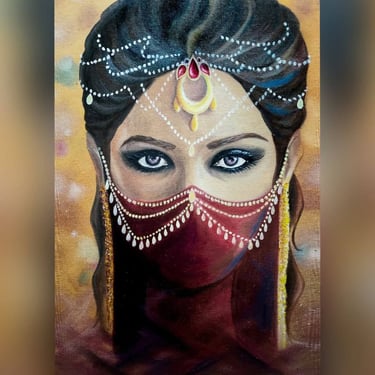
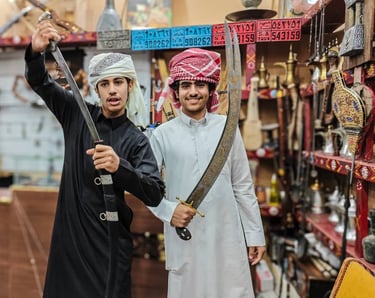
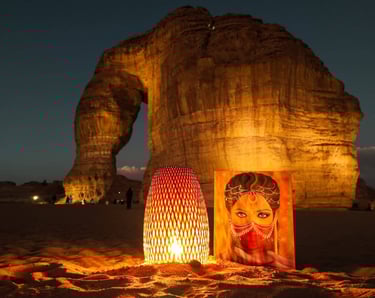
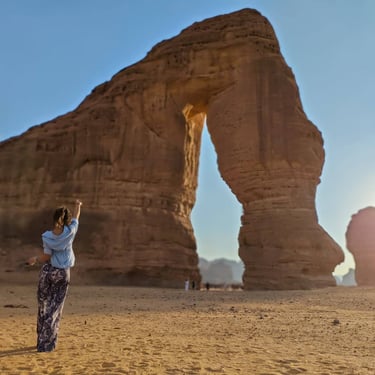
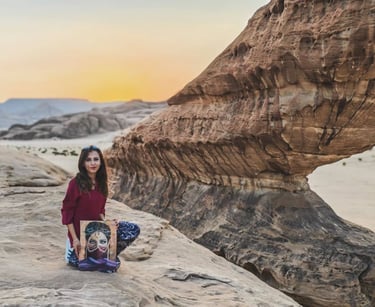
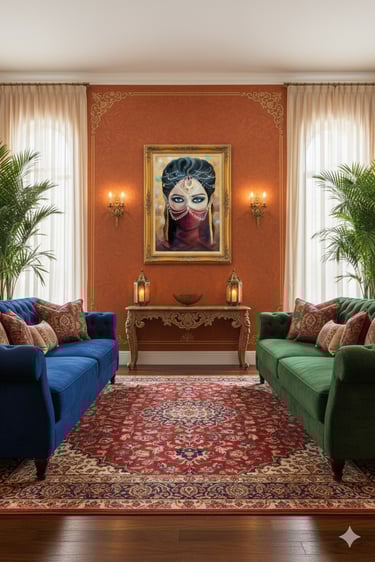
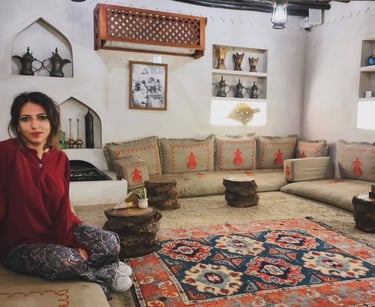
My first trip, my first experience outside of Europe... and what a problem was... that it's difficult to find a more beautiful, more vibrant, or more humanly rich journey than this one.
It all started with the pharmacist: "Doctor, I'm leaving; I need some medications to take with me... Tylenol, antibiotics, cortisone, supplements..."
Doctor: "Well, that's wonderful... and where are you off to?"
Me: "Saudi Arabia."
The pharmacist looked at my mother, directly in the eyes, and said: "Oh, poor mother!" Then she turned back to me: "Do you realize? They are crazy there! You're so comfortable at home, what are you going to do there?"
Fortunately, I chose to trust the right people. Fortunately, I am brave enough. Fortunately, it's not easy to extinguish the curiosity and the desire to always acquire new knowledge within me. Otherwise, it's possible that this statement might have made me cancel the entire trip.
You tell me, in the end, whether the pharmacist was right or not.
If I could use just one word to describe Saudi Arabia and all the people I met, it would be this: the most WELCOMING / ALTRUISTIC people imaginable. I came home with suitcases overflowing with things—many of great value, and many more I couldn't carry and had to leave behind.
But it wasn't just the suitcases that returned overflowing; my heart also came back full of serenity and wonderful experiences, for which a book wouldn't be enough to tell them all.
Starting with the time I lost my phone in Riyadh; everyone did the impossible to help me find it, even illegally contacting the venue's security...
To the evening in Ushaiqer when I was sad and desperate for having lost my phone with all my photos and documents, a beautiful little boy named Ibrahim, holding his veiled mother's hand, came up to me to give me his bag of chips and his beautiful smile. In that moment, I realized how stupid it was of me to have almost wished to go home just for losing my phone...
And when, as we were driving toward AlUla, we asked one of the few passing cars for directions: a kind gentleman, whom I will never forget, accompanied us for about thirty kilometers until the correct turn-off, just to personally ensure we would reach our destination. Not only that, without telling us anything, he got us gas, groceries, and food for the trip—which we didn't even need—just like a father would. How can one ever thank such kindness? Is it even possible?
To Ahmed, who invited us into his home and hosted us as if we were part of his family, giving us valuable camel furs and a snake-repellent stick, which they only do for their dearest friends (even though, for obvious reasons, I didn't adore those furs).
To Mohammed, who gifted us a night in a wonderful resort; to Īsa, who dedicated all his time to help us experience the places, asking for nothing in return.
To everyone who approached us while we walked through the souqs to give us something, including flowers, honey, books, handmade objects, dates, sweets, clothes, and Arabic coffee.
To Zaid, his brother, and his father, who offered us a feast fit for kings just because they guessed we were tourists.
Everything was unforgettable, surreal, absurd, and unexpected.
I did not see strays on the streets, I did not see beggars, I did not see rudeness, no one arguing or rushing, and no one refusing to lend a hand to others.
I did not see dilapidated roads, only huge, brand-new highways in the middle of the desert, even where practically no one drives. Everything is under construction, everything is evolving, everyone drives the latest generation SUVs—and all this can only be possible in a country with a generous, altruistic population, devoid of any form of selfishness.
And the thing that struck me the most: their ability to make friends, with a simplicity and ease that fascinated me every time.
The beauty of this country can only be explained by analyzing these factors: it was a country completely closed off to foreigners and tourism until 2019. COVID then helped preserve it for another three years, so it can be considered a country that had not seen the rudeness of tourists until 2023. But still, few visit it—too many fears and prejudices. And all this beauty remains hidden: everyone wants to give and share something, perhaps precisely because it is a wealthy country.
And then there is Islam, which dictates the maximum and deepest respect and hospitality toward strangers; the natural beauties; the deserts still relatively unspoiled by hordes of noisy tourists. It's impossible to forget the Rainbow Arc, a hidden, faraway beauty where there wasn't a living soul apart from two Sudanese camel drivers, and the most romantic and beautiful sunset I have ever seen... photos don't do it justice.
And the women? Yes, all covered and wearing the hijab. But no obligation forces them to wear it; it is a choice, even if often dictated by the still-active ethical and social norms that impose it. But despite this, they work, they drive, they are increasingly free, and I know they are respected as women far more than in our "free" countries... of course, psychopaths are everywhere, but certainly in much smaller numbers than with us (if we consider the latest Italian crime news, which sends shivers down your spine).
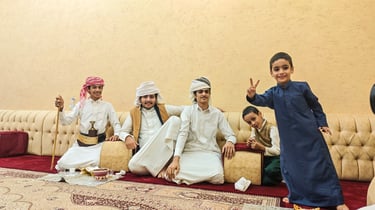
And the marvelous Asir region, among the mountains, villages built in the Yemeni style, and the beautiful city of Najran, right on the border: if people were hospitable throughout the rest of Arabia, here they were so at levels that surpass imagination. I visited the dagger market—objects used as aesthetic ornamentation on clothes—and I can never forget the welcome I received: Ahmed and all his little brothers were overjoyed to show us their country and culture, and despite being the only woman, and not even covered by a hijab, I never for a second felt in danger.
"Is there anything you didn't like about Saudi Arabia?" Yes, and I'm sorry to say it... The thousands of dates I received!
Ideal for collectors and travelers seeking an artwork with a strong cultural and human narrative that challenges judgment and celebrates beauty, dignity, and hospitality beyond geographical and mental barriers.
Support and Materials: Oil on Canvas.30x40 cm
Spirit of Sepik
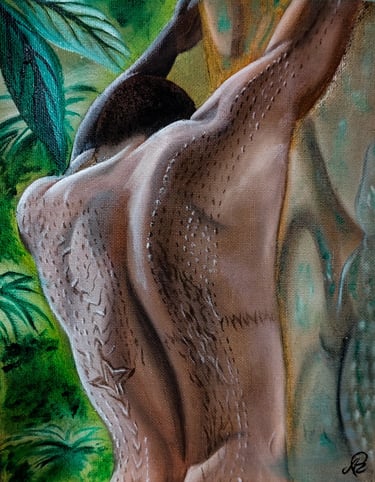
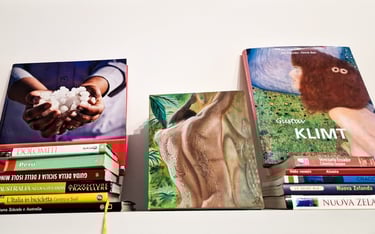
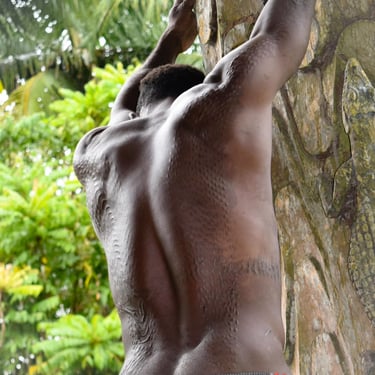
A work that captures the mystical essence and the profound connection between humanity and pristine nature, inspired by the ancestral traditions of Papua New Guinea.
Concept and Inspiration: Inspired by the portraits of a traveler in the Sepik River region, this painting is an homage to the "Spirit of Sepik," an artistic exploration of tribal cultures where the body becomes a living canvas of history, identity, and spirituality. The work evokes the silent strength and ancestral wisdom of populations who live in harmony with a powerful and lush natural world.
The painting focuses on the muscular back of a male figure, immersed in an environment that suggests the depths of the jungle.
The Back as a Canvas: The skin is marked by ritual scars (scarifications) that trace intricate patterns. These markings are not merely decorations but symbols of rite of passage, tribal strength, and belonging. They represent personal and collective history etched directly onto the body.
The figure emerges from a whirlwind of intense greens and deep blues, evoking the dense vegetation of the Sepik River. The skin color merges with earthy and aquatic tones, underscoring the unity between the individual and their natural environment.
Ideal for passionate collectors and travelers seeking a unique piece, capable of evoking stories of distant cultures, profound spirituality, and the power of nature.
Support and Materials: Oil on Canvas 30x40 cm
Hourglass of Life - from Barhein
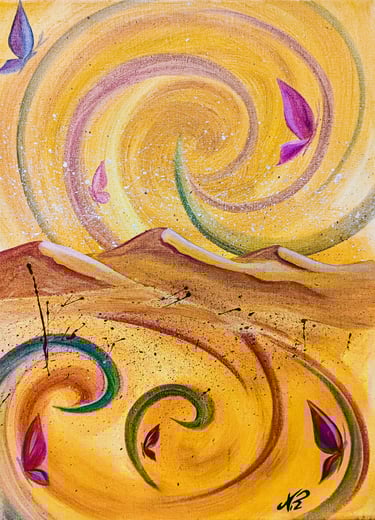
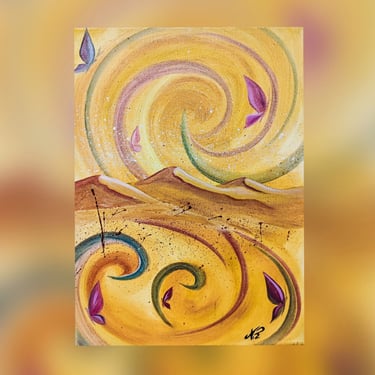
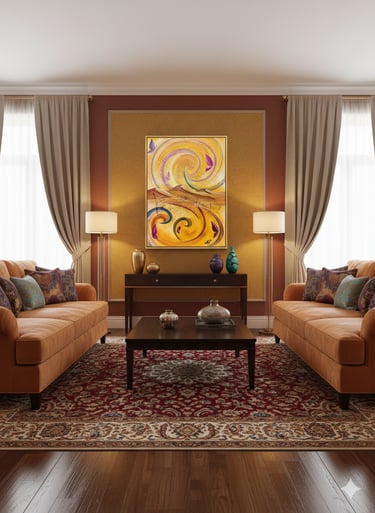
A luminous explosion of yellow and movement that invites reflection on inner freedom and the value of fleeting time.
Inspired by the desert as a symbol of spiritual search and liberty, the painting is a meditation on the fugitive nature of life, where the continuously shifting dunes and dynamic vortices symbolize the Hourglass of Life. It is a reminder to "fill our days with beauty, curiosity, and passion."
Dominated by warm golden and ochre tones, the painting is animated by energetic spirals and butterflies (symbols of transformation) that traverse the landscape. The composition is vibrant and abstract, emphasizing the importance of seizing the meaning and beauty of life in every moment.
Ideal for those seeking an artwork that unites a solar, vibrant aesthetic with a profound philosophical resonance.
Technique, Materials, and Support: Oil on Canvas. 30x40